Family Net Worth Tracker
for India
The simplest way to track your family's complete financial picture — without sharing bank credentials or connecting accounts. Know your net worth. Track your growth.
Sign in to get started. No complex setup.


Why another net worth tracking app?
Most net worth trackers want your bank logins, account access, and financial permissions. That's unreasonable for a simple question:
"How much am I worth, and how is it changing?"
Finworthly answers this with simple manual entries. You already know your balances · just enter them once a week or month. No bank integrations. No complex setup. No privacy concerns.
How it works
Sign in with Google
One click. No account creation. No passwords to remember.
Add your assets & loans
Mutual funds, stocks, FDs, gold, property, vehicles, loans · add what you own and owe.
See your net worth
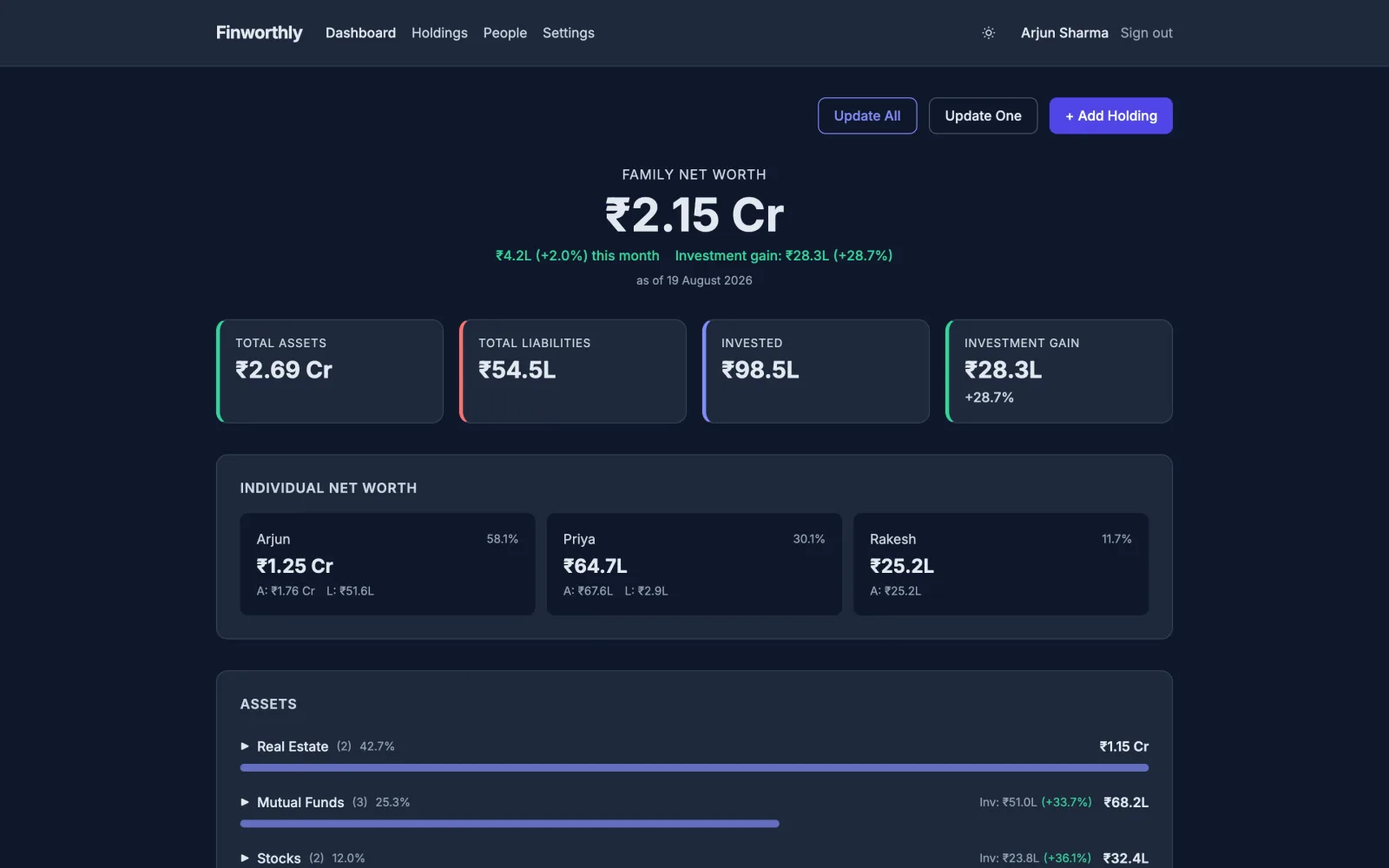
Instant dashboard with family net worth, growth trends, and investment gains.
Everything you need. Nothing you don't.
Family net worth
Track assets and liabilities for every family member · spouse, parents, HUF · all in one household.
Investment tracking
Track invested amount vs current value for mutual funds, stocks, and crypto. See real gains, not inflated numbers.
Growth analytics
Month-over-month net worth trend with percentage growth. See how your wealth changes over time.
No bank access needed
Fully manual entry. We never ask for bank credentials, account numbers, or financial permissions.
Individual breakdown
See each family member's contribution to the household net worth with asset and liability split.
Asset categories
22 built-in types · Mutual Funds, Stocks, FDs, Gold, EPF, PPF, NPS, Real Estate, Vehicles, and more.
Bulk update
Update all your holdings at once. Pre-filled with last known values · just change what's changed.
Family sharing
Add a family member's Gmail. They can sign in and update their own holdings independently.
CSV export
Download your complete net worth snapshot as a CSV file anytime.
Dark & light theme
Easy on the eyes at any time of day. Your preference is remembered.
Custom categories
Need a category that doesn't exist? Create your own asset or liability types.
Mobile friendly
Works on any device. Designed for quick updates on the go.
Track all Indian financial instruments
From everyday savings to long-term investments, Finworthly supports all major Indian financial instruments.
Built for real families
Individuals
Track your personal assets, investments, and loans in one place. See your net worth grow month over month.
Families
Add spouse, parents, and children. See the complete household financial picture with individual breakdowns.
HUF & joint assets
Track family-owned assets under a separate entity. Keep personal and family finances organized.
What belongs in your net worth
Net worth is everything you own minus everything you owe. The arithmetic is trivial; the hard part is remembering the whole list, and in India the list is specific.
Assets to include
- Market-linked — mutual funds, direct equity, ETFs, anything in a demat account.
- Retirement — EPF, VPF, PPF, NPS, vested gratuity. Usually the largest line for salaried households, and the one most often left out.
- Small savings — Sukanya Samriddhi, NSC, KVP, Post Office schemes, SCSS.
- Deposits — fixed and recurring, including banks you no longer use.
- Gold — jewellery, coins, Sovereign Gold Bonds, digital gold, gold ETFs.
- Property — self-occupied, let out, under construction, plots, ancestral land.
- Insurance with surrender value — endowment, money-back, ULIP. Pure term cover is not an asset.
- Everything else — unlisted shares, ESOPs, money lent to relatives, vehicles, business capital, HUF assets.
Liabilities to subtract
- Home loan, loan against property, and any top-up balance.
- Car, personal, education and gold loans.
- Credit card outstanding, including anything converted to EMI.
- Loans against securities, PPF or insurance policies.
- Informal borrowing from family, which counts even though no institution recorded it.
What is not an asset
Two things get miscounted often enough to state plainly. Your salary is income, not a holding — it changes your net worth through what you keep, but it is not a line on the balance sheet. And term insurance cover is not an asset, because it pays out only on a claim.
Net worth tracker, portfolio tracker, or budgeting app?
These three get confused constantly, and they answer different questions.
Budgeting app
Tracks money moving through your accounts — what came in, what went out, what category it fell into. It is about cash flow this month.
Portfolio tracker
Follows market-linked investments and measures returns. It will tell you your equity is up 14%. It will not tell you net worth fell because you drew down a car loan, and it usually has no concept of your flat or your gold.
Net worth tracker
Covers the entire balance sheet, including assets with no return and the debts set against them. It answers a slower question: is the household getting wealthier, and because of what? Finworthly is this kind.
Want the one-off figure rather than a series? Use the net worth calculator — no sign-up needed.
Frequently asked questions
What is Finworthly?
+
Does Finworthly need my bank login or account access?
+
Can I track my family's net worth?
+
What types of assets can I track?
+
Can family members update their own holdings?
+
How is net worth calculated?
+
How to track net worth without bank access?
+
Should I include EPF and PPF in my net worth?
+
How to include real estate in net worth calculation?
+
Is Finworthly the best net worth tracker for Indian families?
+
Is my salary part of my net worth?
+
How often should I update it?
+
How do I value property or jewellery I am not selling?
+
What is the difference between this and a portfolio tracker?
+
Can I track my parents' and children's assets too?
+
Where is my data stored, and can I get it out?
+
Is there an official benchmark for net worth by age in India?
+
Start tracking your net worth today
Takes 5 minutes to set up. No bank access needed.
Guides
Net Worth Tracker for India: How to Choose One
Account aggregators, manual trackers or a spreadsheet — what each approach covers and what it misses.
How to Calculate Your Net Worth in India
Step-by-step guide to calculating your complete net worth with Indian financial instruments.
EPF vs PPF vs NPS — Track Your Retirement Funds
Understand the differences and how to include retirement funds in your net worth.
Track Family Wealth Without Bank Access
Why manual tracking is more private and practical for Indian families.
Track All Investments in One Place in India
What a PAN-based CAS covers, what it misses, and how to build one complete view.
Net Worth Tracker Excel Template for India
A monthly tracker for Excel and Google Sheets with Indian asset categories and a trend chart.
Average Net Worth in India
Household assets, debt and net worth from the government's AIDIS survey, rural vs urban.